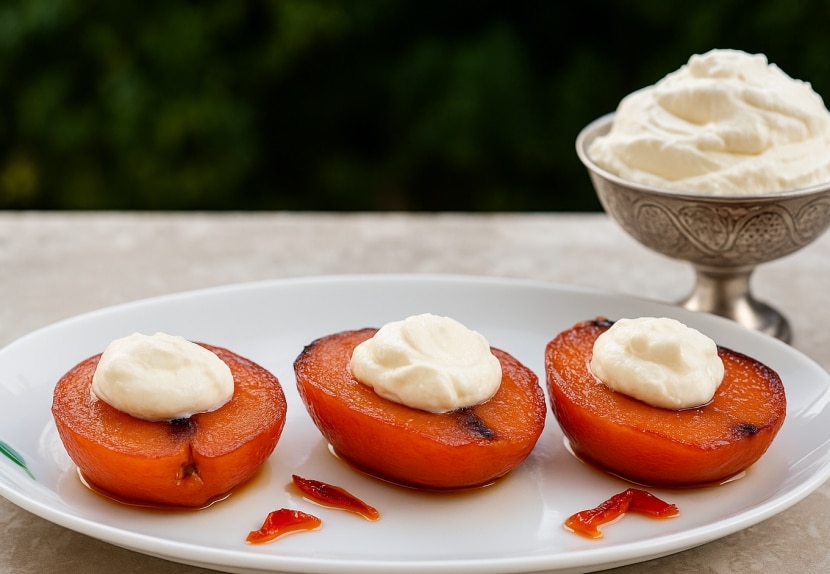
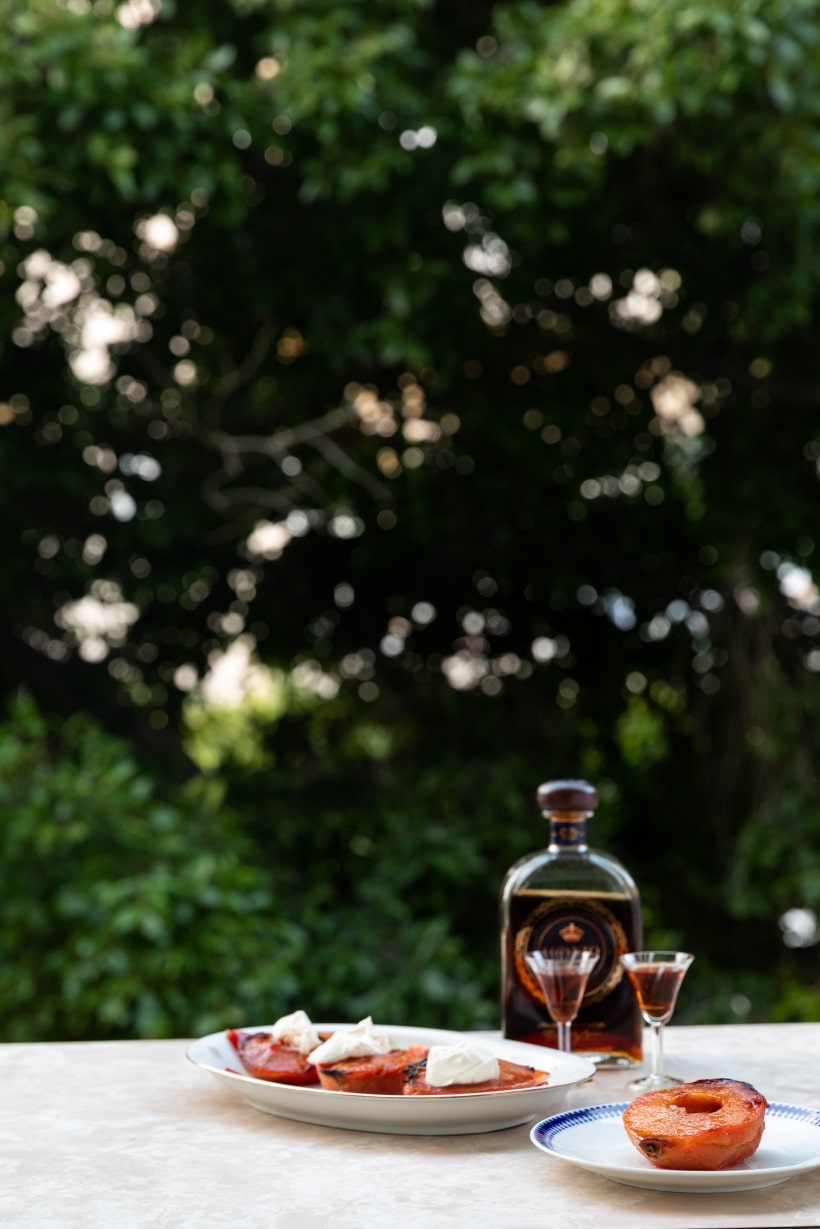
Ayva Tatlısı, the Turkish quince dessert, is a Turkish cuisine classic. Quince halves, cooked in syrup until tender and deep, amber-red color.
The dessert is then garnished with chopped walnuts and sevred alongside kaymak.
More Sephardic recipes on Rex:
Turkish Stuffed Zucchini – Kabak dolmasi
A Journey Through Cultures: The History of Quince Desserts
The Turkish quince dessert originates from the Izmir region. It's a relatively modern evolution of dishes prepared in the area since ancient times.
Quince (Cydonia oblonga) comes from the region of Northern Iran and Eastern Caucasus. From there, it spread to the Mediterranean basin and Asia Minor. In Greece, quince was first cultivated in Crete and was considered a symbol of beauty. It's likely that the term "golden apple," originating from Greek mythology, actually referred to quince.
In Mesopotamia, quince was more common than apples due to its heat resistance. It is mentioned under various names in Aramaic and Arabic and was used as medicine, while in Judaism it was associated with love – and it is likely that the "apple" in the Song of Songs was actually quince.

Quince desserts in Asia Minor
In ancient Rome, quince was used in sweets and marmalades with honey and wine. The Roman cookbook of Apicius contains recipes for cooking quince in honey. A local recipe in Asia Minor for quince cooked in honey and cherries dates to 72 BC.
The Byzantine Empire, which succeeded Rome in the East, adopted the practice of cooking candied fruits. During this period, sugar production was still in its infancy, and honey and dried fruits were used to sweeten desserts. The preparation technique arrived with the Moors to the Iberian Peninsula, where quince was a significant fruit.
The technique for making marmalade came with them to Western Europe, including quince paste (membrillo).
Iberian Christians adopted the recipe until it became part of their cuisine, and the term "marmalade" originates from the Portuguese verb for making quince jam. By the 15th century, quince marmalade was already common in Portugal, Spain, Italy, and France.
Later, with the conquest of Constantinople in 1453, the Ottomans inherited the widespread use of fruits and the combination of sweet-sour flavors from the Byzantines.

So What Exactly is Ayva Tatlisi Dessert?
The origin of the modern Turkish Ayva Tatlısı quince dessert is in the Izmir region. Its recipe is a cultural synthesis, combining the Roman-Byzantine tradition of cooking quince in honey with Persian techniques for creating concentrated quince preserves, which the Ottomans were familiar with from Central Asia.
The first written mention of the dessert in its current version appears in the first cookbook published in the Ottoman Empire, Melceü’t-Tabbâhîn (1884).
Over the years, the dessert developed and was refined. Longer cooking over low heat for thickening and color, improved presentation with kaymak and walnuts.
The path of quince recipes' spread was multi-directional and integrated. Sephardic Jews arriving from Spain played a part in its popularization in Ottoman cuisine. The use of quince was deeply rooted among Iberia's expelled Jews.
The expelled Jews who reached Italy, the Netherlands, and North Africa continued to prepare quince sweets and spread them. Thus, for example, "Cotognata" recipes appeared in Southern Italy under their influence. When they reached the cities of the Balkans and Asia Minor, they carried with them their language (Ladino – also known as Judeo Espagnol), but also recipes.
Bimbriyo en Almibar (quince in syrup) and Dulce de Bimbrio (quince sweet/paste). Among the Jews of Izmir, quince jam is a traditional food for Rosh Hashanah. In Istanbul, it was customary to recite a blessing over the quince fruit on Rosh Hashanah with the text, "May it be Your will that the new year be good and sweet for us like quince in honey."
In many ways, the quince preparation methods arrived with them from the Middle East to Spain – and returned with them to the region in the 16th century, after the Spanish Expulsion.
Ayva Tatlisi – Turkish Quince dessert
Recipe by Roy Yerushalmi. The original Jewish-Sephardic recipe is a minimalist version of the popular Istanbul dessert.
It contains no spices, and the sauce includes only sugar, water, and lemon. Spices can be added to deepen flavors, see 'Optional additions' in the recipe.
This is a forgiving and easy dessert. For it to be perfect, it requires attention, ensuring the quinces are soft but still firm.
Also: It's important to save the quince seeds when preparing the dessert. They contain pectin, helping thicken the syrup. Thus, they significantly contribute to achieving the dessert's characteristic deep red color.
Shortcut: omit the oven – cook the quinces on low heat for about one and a half to two hours.
Ingredients for a wide, shallow pot, suitable for oven use:
3 medium quinces, peeled, halved, and cored (Important: set the seeds aside)
3/4 cup white sugar
Juice from 1 large lemon
Optional additions:
2 tsp rosewater or orange blossom water
2-3 geranium leaves
2 cardamom pods
6 cloves.
For serving:
Crème fraîche, kaymak, or whipped cream
Chopped walnuts
Preparation:
Bring the lemon juice, quince seeds, and sugar to a gentle boil. Add the quince halves and pour in water just to cover them. Bring to a boil again. Cover the pot and simmer over medium-low heat for about half an hour.
Transfer the pot to an oven preheated to 170°C (340°F) and keep it covered. Bake for at least an hour, or until the quinces are red and soft but still hold their shape. If the sauce is still too liquidy, you can transfer it to a small saucepan and continue to reduce it over heat until it reaches the desired consistency. Let the quinces cool and set in the syrup at room temperature for at least an hour before serving.
Serving: Sprinkle chopped walnuts over the quinces. Place a spoonful of crème fraîche (or kaymak/whipped cream) in the hollow center of each half. Serve lukewarm or cold.